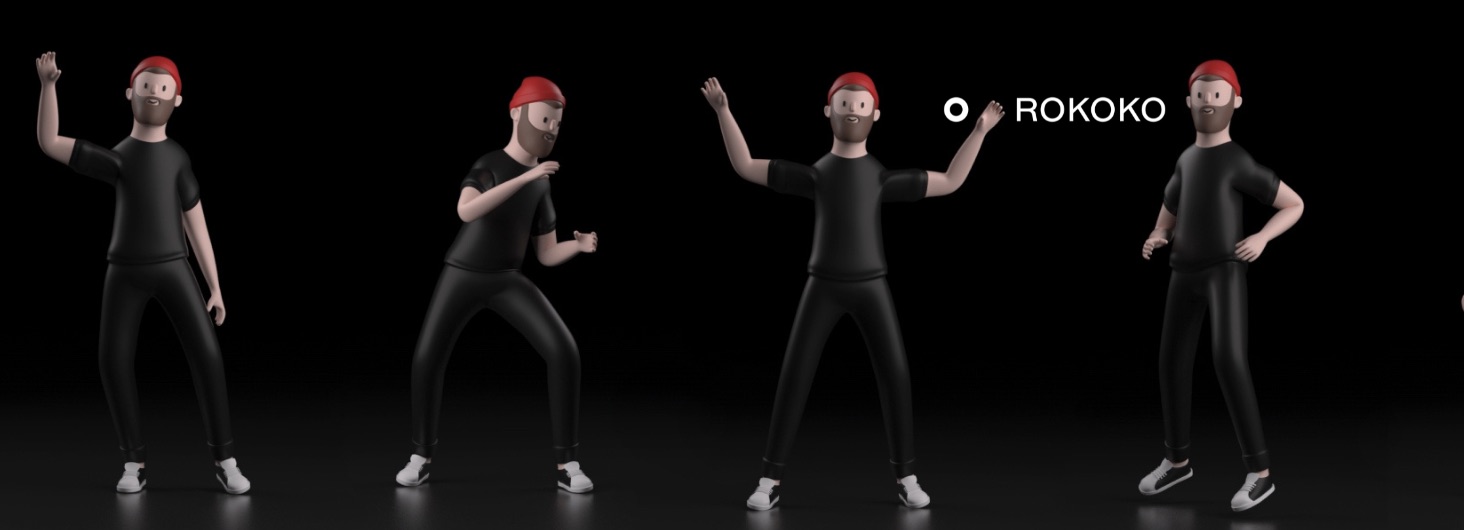
Introducing Rokoko Vision 3.0: Faster, better, and built for iteration
Today we’re launching Rokoko Vision 3.0 - a complete rebuild of our monocular AI motion capture pipeline and the biggest leap forward since Rokoko Vision first launched. The new solver captures cleaner motion, processes footage faster than any competitor, and brings Video-to-Motion directly into web-based Rokoko Create platform alongside Text-to-Motion.
But the biggest improvement isn’t just better quality. It’s momentum.
Creating animation should be an iterative process. Record. Process. Review. Adjust. Repeat. The faster that loop becomes, the better your final animation gets. Vision 3.0 was built around exactly that idea. Whether you’re capturing reference, blocking out gameplay, prototyping a cinematic, or producing final animation, Vision 3.0 keeps the creative process moving.
From performance to finished animation, faster
AI motion capture has evolved quickly over the past few years. More tools exist than ever before, giving creators a wider range of options depending on their workflow.
Some solutions process everything locally. Others process in the cloud. Both approaches have advantages.
Local processing gives creators complete control over where computation happens. Cloud processing removes the need for powerful hardware and lets creators keep working while footage is processed.
We believe the bigger question isn’t where motion gets processed. It’s how quickly creators can move from performance to finished animation.
That’s why we built Vision 3.0 around cloud processing. Upload your footage from any browser, continue working while your animation is generated, and come back to finished motion - without waiting for lengthy local processing, installing a full game engine, or requiring a high-end GPU.
This makes Vision 3.0 accessible to creators regardless of whether they work in Blender, Maya, Unity, Unreal Engine, or somewhere else entirely.
Creators comparing Rokoko Vision with local-processing solutions such as MetaHuman Animator from Epic Games inside Unreal Engine are ultimately choosing between two different workflows.
Today, MetaHuman Animator performs processing locally on your machine, while Rokoko Vision leverages cloud infrastructure to dramatically reduce turnaround time and let you continue working while your animation is generated. Local processing gives creators complete control over their data, but it also means processing speed depends entirely on the hardware available - and it can be really time-consuming even on a quite beefy machine.
More motion. Less waiting.
Iteration is the hidden cost of animation.
The first take is rarely the best one. Great animation comes from trying ideas, adjusting performances, comparing versions, and refining timing. That’s difficult when every processed minute feels expensive. It’s also difficult when every take leaves you waiting for long local processing before you can continue.
Vision 3.0 was designed to remove both kinds of friction.
Our cloud infrastructure processes footage dramatically faster than previous versions of Rokoko Vision while giving creators substantially more monthly processing than comparable cloud-based AI mocap solutions.
At a creator tier:
At a professional tier:
For creators using cloud AI mocap, Rokoko delivers dramatically more motion for the same monthly investment.
More importantly, it lets you experiment without constantly thinking about credits. Rokoko Create features a clear, transparent subscription model, where you can focus entirely on perfecting your animation without ever worrying about confusing credit systems, hidden token costs, or unexpected usage fees.
The result is a workflow where iteration becomes the default instead of the exception.
One platform for all motion creation
Vision 3.0 isn’t a standalone utility. It isn’t a feature buried inside a larger application. It’s part of a complete motion creation platform.
Motion creation increasingly spans multiple technologies. Sometimes you start with a text prompt. Sometimes with a performance. Sometimes by editing an existing animation. Those experiences shouldn’t live in separate products.
Video-to-Motion and Text-to-Motion now live together inside Rokoko Create. Instead of jumping between separate tools, creators can capture motion from video, generate entirely new performances from text, edit them, organize them, and prepare them for production in one unified workspace. This is where future AI-powered motion tools will arrive as well.
Inside Rokoko Create you can:
- Generate motion from text
- Capture motion from video
- Edit & refine animations in Rokoko Studio
- Organize your motion library
- Retarget characters
- Export instantly in all standard formats
- Expand with Rokoko hardware whenever your projects require it
Rather than solving one isolated problem, we’re building a platform that supports the entire journey from idea to finished animation. Our ambition is to build the best platform for creating digital motion.
A new generation of Rokoko Vision
When we first launched Rokoko Vision, our goal was simple: Make motion capture accessible to anyone with a camera. That mission hasn’t changed. What has changed are creator expectations.
Quality matters more.
Speed matters more.
Workflow matters more.
Instead of continuing to iterate on the original architecture, we rebuilt the monocular solver from the ground up. The result is cleaner animation, faster processing, and a dramatically smoother experience throughout the entire workflow.
Vision 3.0 represents the foundation for everything we’ll build next.
What happens to previous Rokoko Vision?
Vision 3.0 replaces the previous single-camera version of Rokoko Vision. For creators using the dual-camera workflow, support will remain available for approximately 30 days following launch before being retired. Going forward, Rokoko Create becomes the home for AI-powered motion creation across the Rokoko ecosystem.
Why we removed webcam recording
One noticeable change is the removal of direct webcam recording. This wasn’t driven by technical limitations. It came directly from how creators were already working.
More than 90% of Vision users preferred recording separately before uploading their footage. That gave them the opportunity to review framing, lighting, camera placement, and performance before processing. Rather than maintaining a feature most users no longer relied on, we invested those resources where they matter most: motion quality, processing speed, and overall usability.
What about finger tracking?
Vision 3.0 launches without finger tracking. That decision was intentional.
Our feedback consistently showed that creators valued body quality, processing speed, workflow simplicity, and accessibility above all else. Those became our priorities for this release.
As always, we’ll continue listening closely to the community as Vision evolves.
The future of motion creation
AI is changing how animation gets made. Motion capture is becoming faster. Generation is becoming more powerful. Editing is becoming smarter. The boundaries between those workflows are disappearing. We believe the future belongs to platforms that bring all of those capabilities together in one place.
Vision 3.0 is a major step toward that future.
Cleaner animation. Faster turnaround. A better creative workflow. And a platform built for the next generation of motion creation.
We’re just getting started.
{{cta}}
.jpg)

.jpg)


