The state of motion capture in 2026: What 3,757 creators told us
The last few years have brought some of the biggest changes the 3D content creation industry has seen in decades. Generative AI can now create increasingly convincing images and videos from a prompt. Video-to-motion capture has improved dramatically. Game engines are becoming content creation platforms in their own right. And new AI tools seem to launch almost every week.
But how much has all of this actually changed the way 3D creators work?
We recently surveyed 3,757 people working with motion capture and 3D content creation to get a snapshot of the industry in 2026 - who is creating, which tools they’re using, how AI fits into their workflows, and where they’re continuing to invest.
The results surprised us in a few places.
AI adoption is real, but much less mature than the hype might suggest. Dedicated motion capture remains firmly embedded in creators’ workflows. Unreal Engine has opened a remarkable lead among 3D tools. And for the first time in our surveys, game development has become by far the largest field represented. Before getting into the results, an important caveat: this isn’t intended to be a census of the entire 3D industry. The survey was promoted by Rokoko, so the audience naturally skews toward people already interested in motion capture - and almost certainly toward Rokoko users as well.
That makes absolute market-share conclusions difficult. But with almost 3,800 responses, we think the results still offer a fascinating look at how a large group of active 3D creators are working today - and how that is changing.
Who responded?
Our respondents ranged from full-time studio employees and independent creators to students, researchers and hobbyists.
- Teacher/Student: 44%
- Freelance/Independent creator: 30%
- Hobbyist: 15%
- Studio or full-time employee: 9%
- Researcher/engineer/technician: 2%
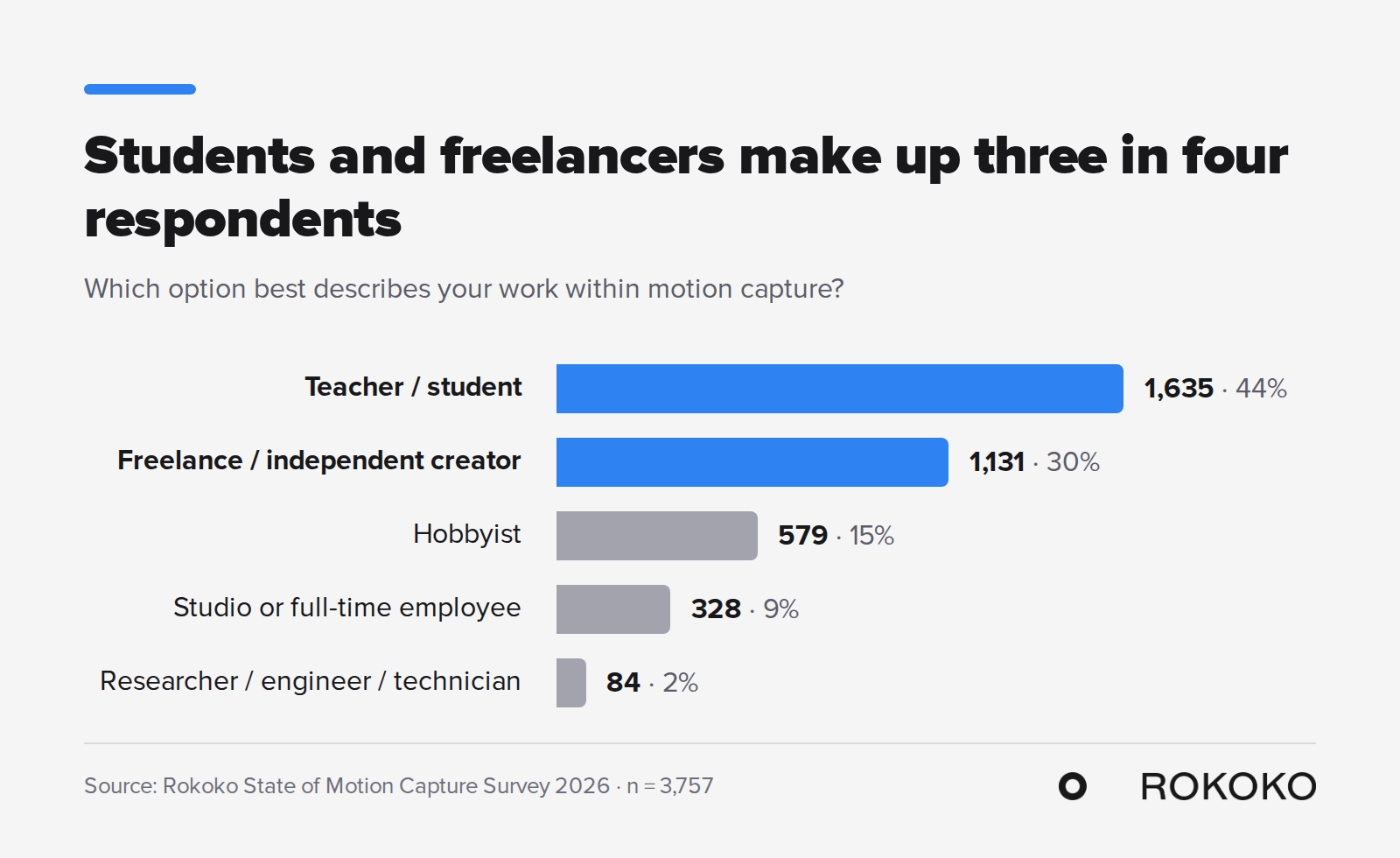
Students and teachers represented the largest group, followed by freelancers and independent creators. We also saw substantial participation from hobbyists and people working full-time at studios. But the more interesting shift appeared when we asked what people were actually creating.
Game development was the largest category among the respondents
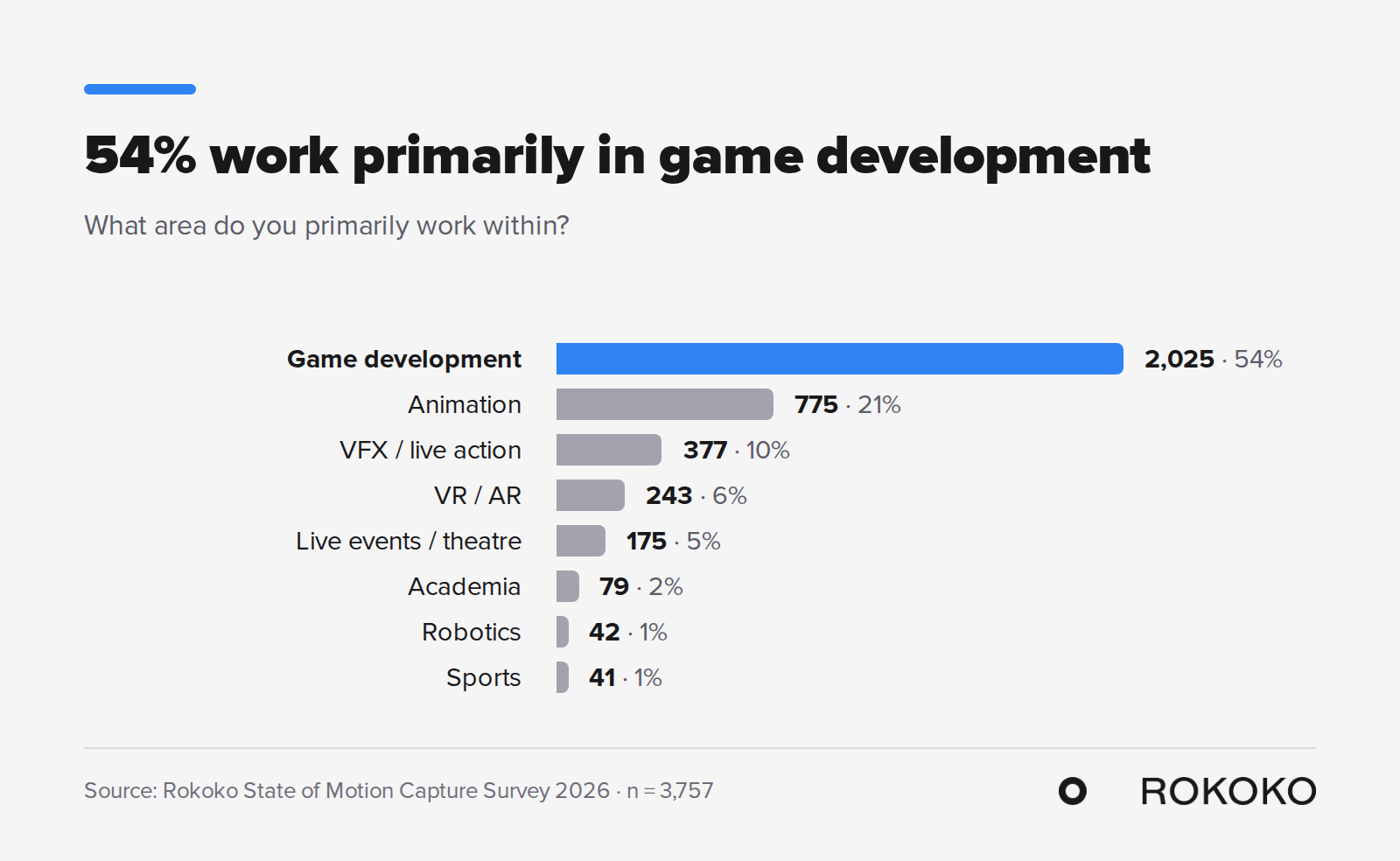
More than half of respondents - 2,025 out of 3,757, or 54% - said game development was their primary field.
Animation came in a distant second at 775 respondents, followed by VFX/live action at 377 and VR/AR at 243.
For us, this is particularly interesting because it represents a change from what we’ve seen in previous industry surveys. Historically, animation and VFX have made up a larger share of the motion capture audience, with game development playing a significant but secondary role. That relationship has now flipped.
There are probably several forces behind this. Real-time engines have become vastly more capable. High-quality 3D production has become accessible to much smaller teams. And the boundary between “game development” and other forms of real-time 3D creation is increasingly blurry. Whatever the exact cause, our 2026 results suggest that motion capture is becoming increasingly intertwined with game development and real-time production.
And the tools people use reinforce that picture.
Unreal Engine is leading the way among the 3D tool stack
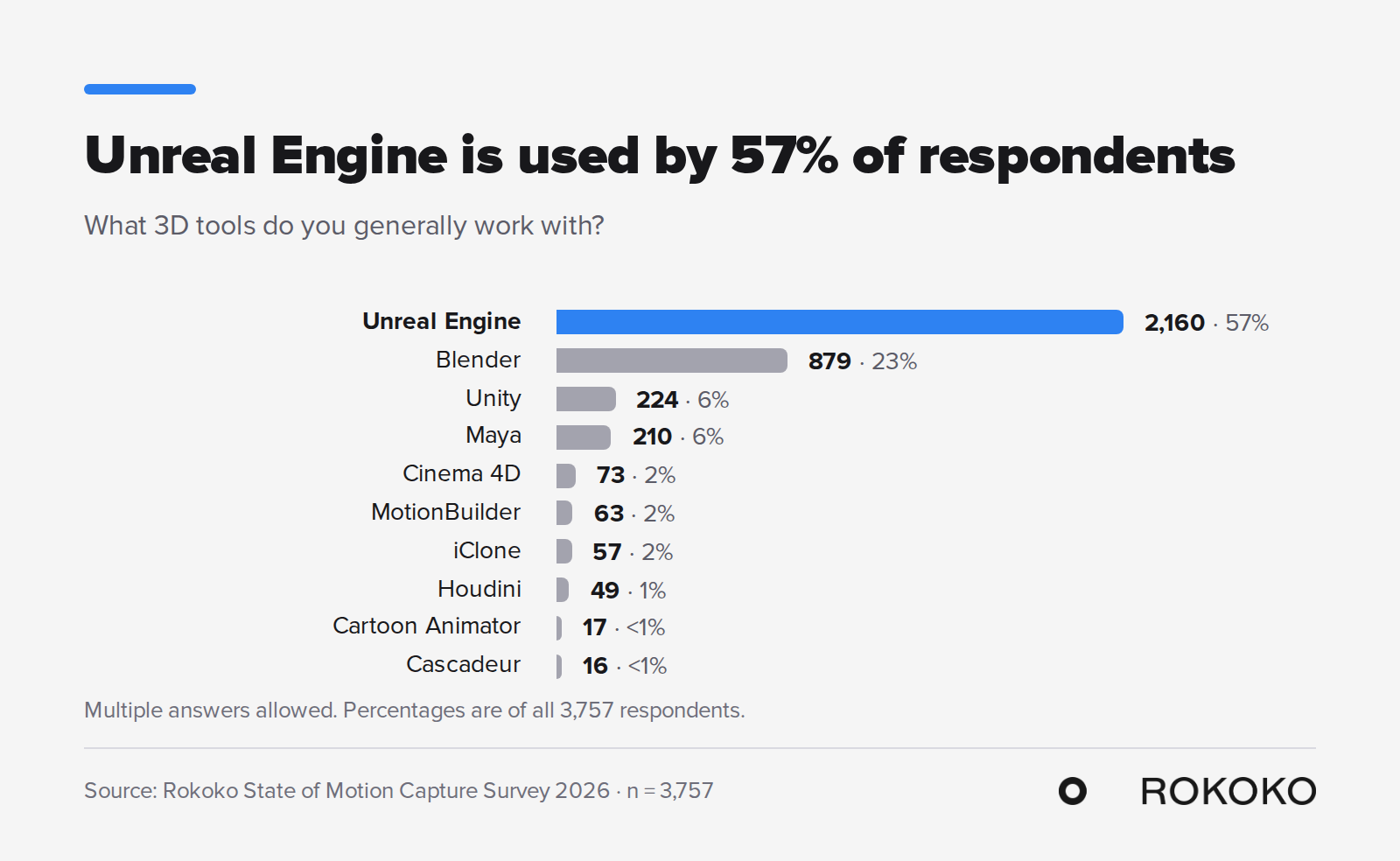
One of the clearest results in the entire survey was the position of Unreal Engine.
2,160 respondents said they work with Unreal Engine, compared with 879 for Blender, 224 for Unity and 210 for Maya.
Because respondents could work across multiple tools, these numbers shouldn’t be read as mutually exclusive market shares. But the relative scale is striking. In earlier surveys, Unity and Unreal Engine were much closer. More recently, Blender emerged as another huge part of the creator ecosystem, particularly among independent and price-conscious creators.
In this year’s survey, Unreal Engine is in a category of its own. Nearly 57.5% of all respondents reported using Unreal Engine, versus 23.4% for Blender and just 6% for Unity. That may be one of the clearest indications of how much the 3D creation landscape has changed. Unreal is no longer simply one game engine among several. For a large part of this audience, it has become the central environment where real-time 3D work happens.
Motion capture itself looks surprisingly resilient
With the enormous attention around generative AI and AI-based video-to-motion tools, we might have expected the motion capture stack to look radically different in 2026.
It doesn’t.
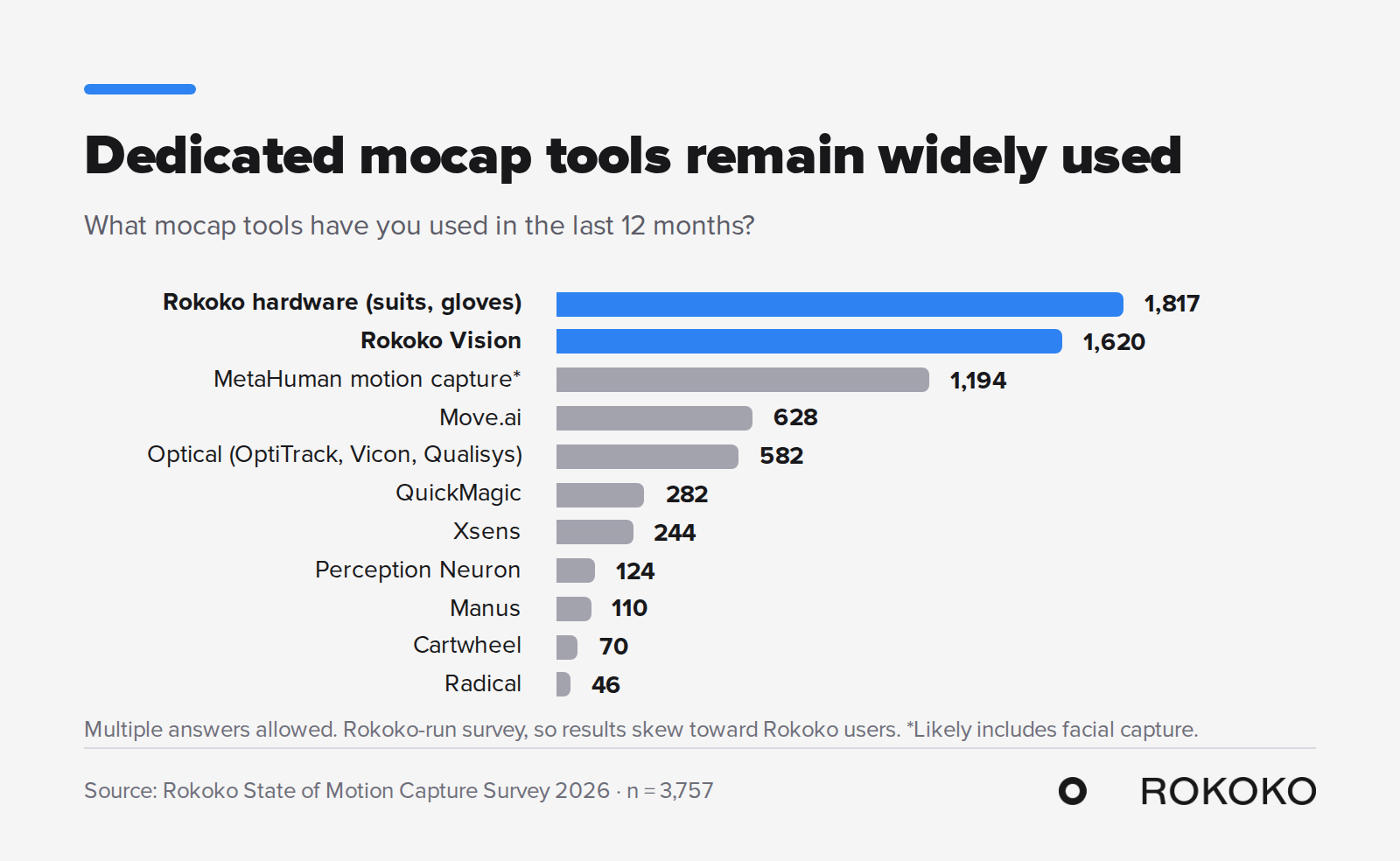
Rokoko hardware was the most commonly used motion capture solution in the survey, reported by 1,817 respondents, while 1,620 had used Rokoko Vision.
We should put a very large asterisk next to those numbers: this was a Rokoko-run survey promoted through our own channels. It would therefore be unreasonable to interpret the result as saying that Rokoko has 7x the overall market share of Xsens, for example. Still, the size of the difference is notable even with that bias in mind. And from our perspective, it’s encouraging to see both our hardware and camera-based mocap being used at this scale across the audience.
More broadly, the chart shows a fragmented motion capture ecosystem rather than one that has suddenly been replaced by AI.
Optical marker-based systems such as OptiTrack, Vicon and Qualisys were used by 582 respondents. Move.ai was used by 628. Xsens by 244. QuickMagic by 282. Perception Neuron by 124 and Manus by 110.
MetaHuman motion capture was reported by 1,196 respondents, although there is an important qualification to that number.
Our question wasn’t specific enough about body motion capture. MetaHuman Animator is widely used for facial capture as well, and its new video-to-body-motion capabilities were only recently introduced. As a result, this number almost certainly includes many respondents using MetaHuman Animator for facial capture alongside another solution for body capture. We therefore wouldn’t treat the MetaHuman number as a direct comparison with the other body motion capture solutions in the chart. In fact, facial capture and body mocap are often complementary parts of the same pipeline.
The larger point is more interesting anyway: there hasn’t been a wholesale replacement of dedicated mocap systems by generative AI.
AI is everywhere. But mostly around the edges of production.
We also asked respondents directly how deeply generative AI video and 3D tools have made it into their professional workflows.
The answer is more nuanced than you might expect.
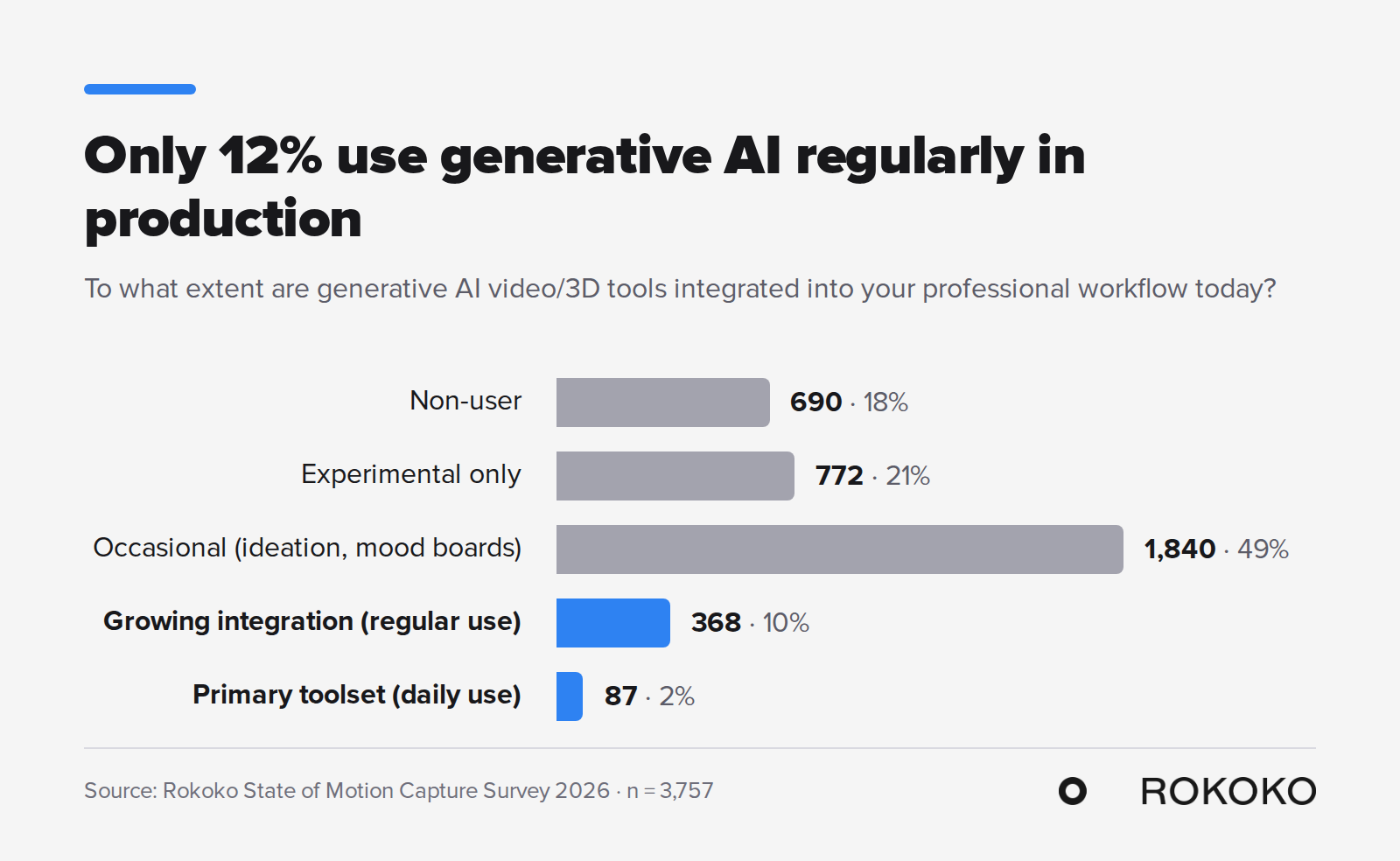
Only 87 respondents - 2.3% - said generative AI tools had become a primary toolset used daily and had already replaced several established steps in their workflow. Another 368, or 9.8%, said AI was becoming regularly integrated and that they expected it to become a core part of their pipeline.
The much larger group was somewhere earlier in the adoption curve.
1,840 respondents - almost 49% of the entire survey - said they used generative AI occasionally, primarily for mood boards or early-stage ideation. Another 772 were experimenting with it but had not incorporated it into production. And 690 said they weren’t using generative AI tools at all. In other words, only around 12% described generative AI as either regularly integrated or already a primary part of their workflow. That’s a long way from “AI isn’t being adopted.” It clearly is.
But it suggests that the role of AI in professional 3D creation today is still much more frequently additive than substitutive. Creators are adding AI to parts of their workflow rather than replacing the underlying production pipeline.
Creators are paying for AI - even before it becomes core to their workflow
Interestingly, willingness to pay is considerably further along than deep workflow integration.
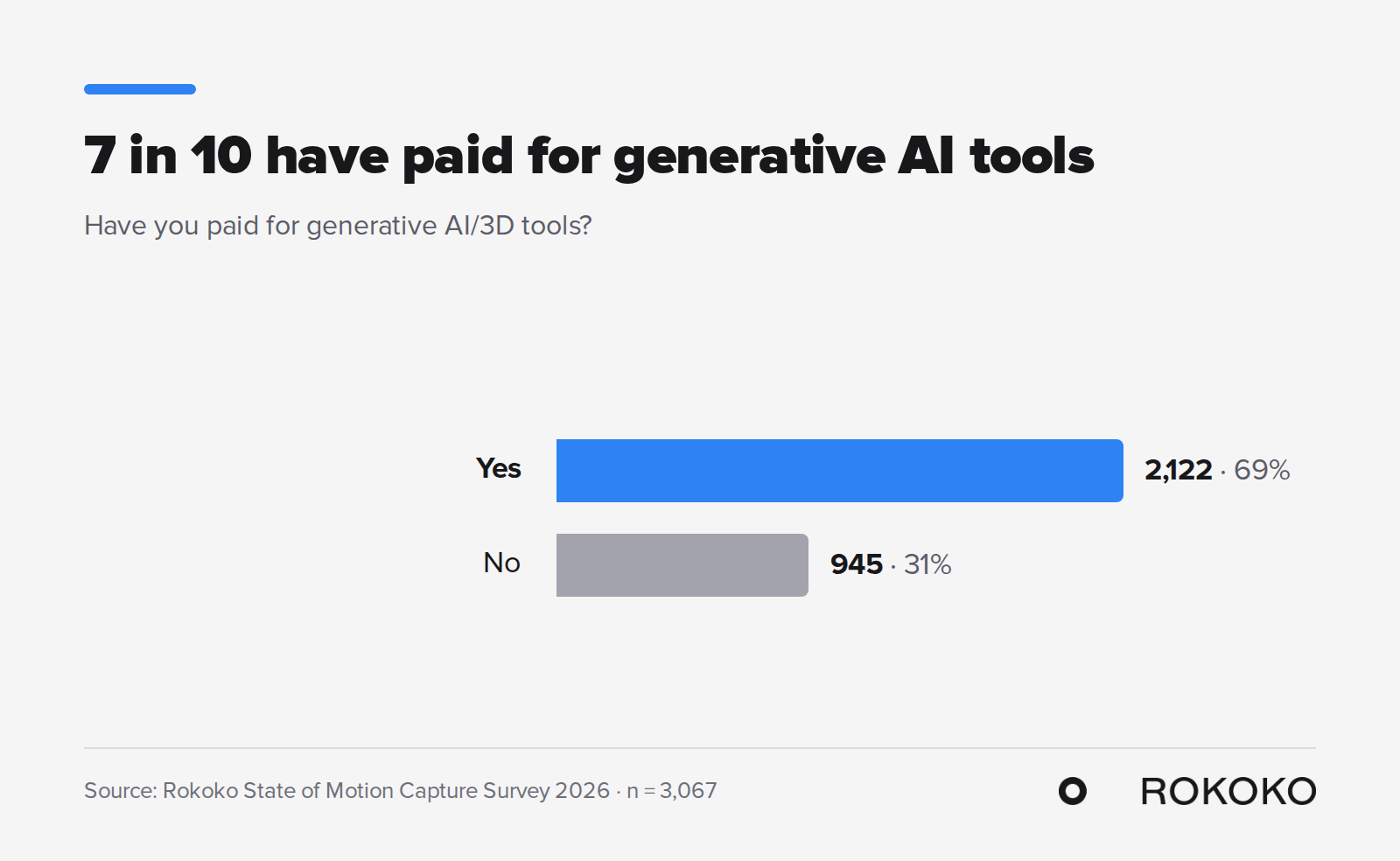
Among respondents to this question, 69.2% had paid for generative AI or 3D tools, while 30.8% had not. That suggests experimentation with AI isn’t purely casual. Creators are willing to spend money exploring what these tools can do, even when they haven’t yet become central production tools.
We also asked which generative AI products respondents had actually used.
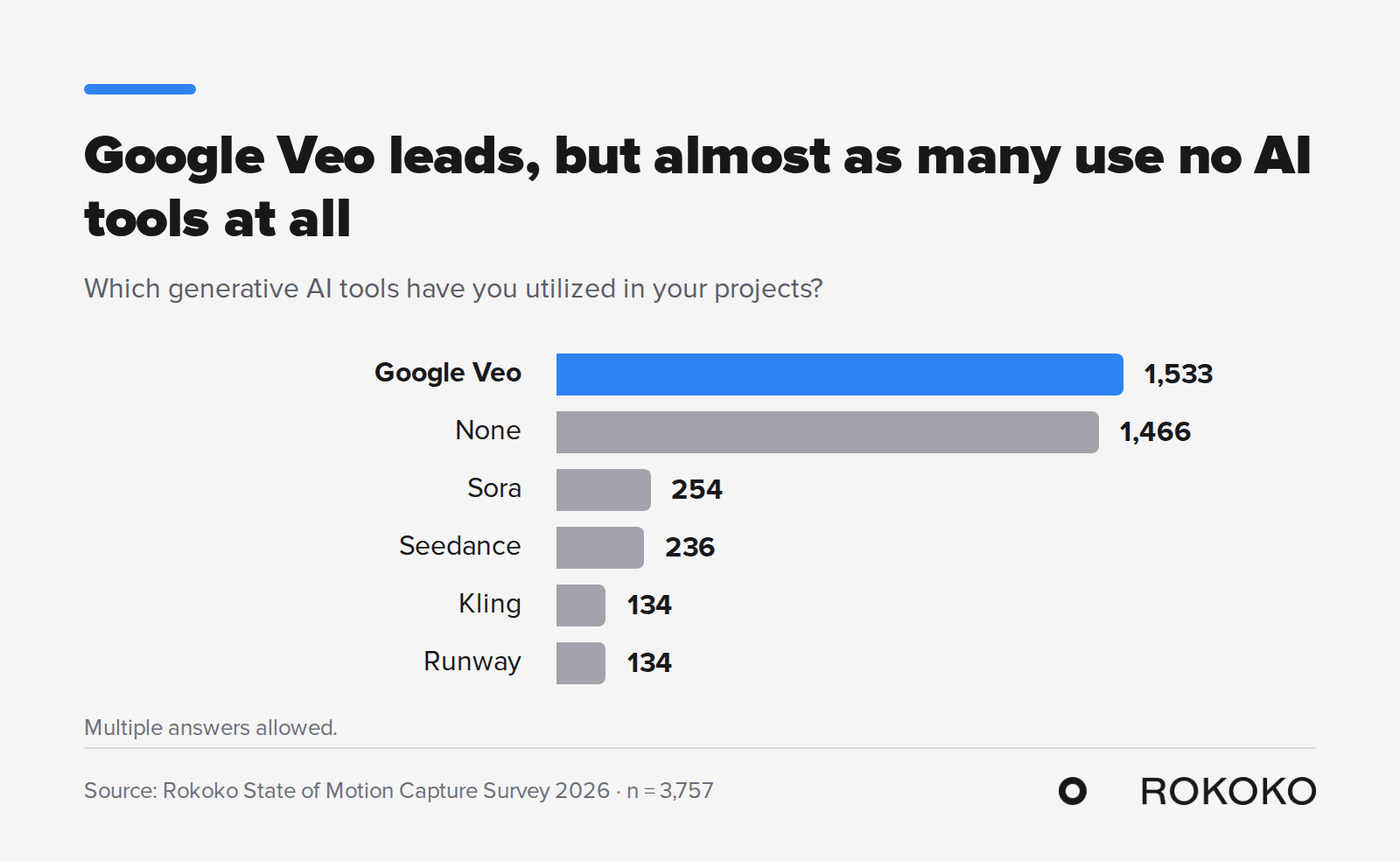
Google Veo was by far the most commonly reported tool, with 1,533 respondents, followed by Sora at 254 and Seedance at 236. Kling and Runway were each reported by 134 respondents. At the same time, 1,466 respondents selected “None.”
The picture is one of an industry actively experimenting - but still figuring out where these technologies belong in a real production pipeline.
Perhaps the biggest surprise: AI isn’t reducing investment in mocap
This was the result we found most interesting.
We asked directly whether the rise of generative AI had changed respondents’ investment in dedicated motion capture solutions.
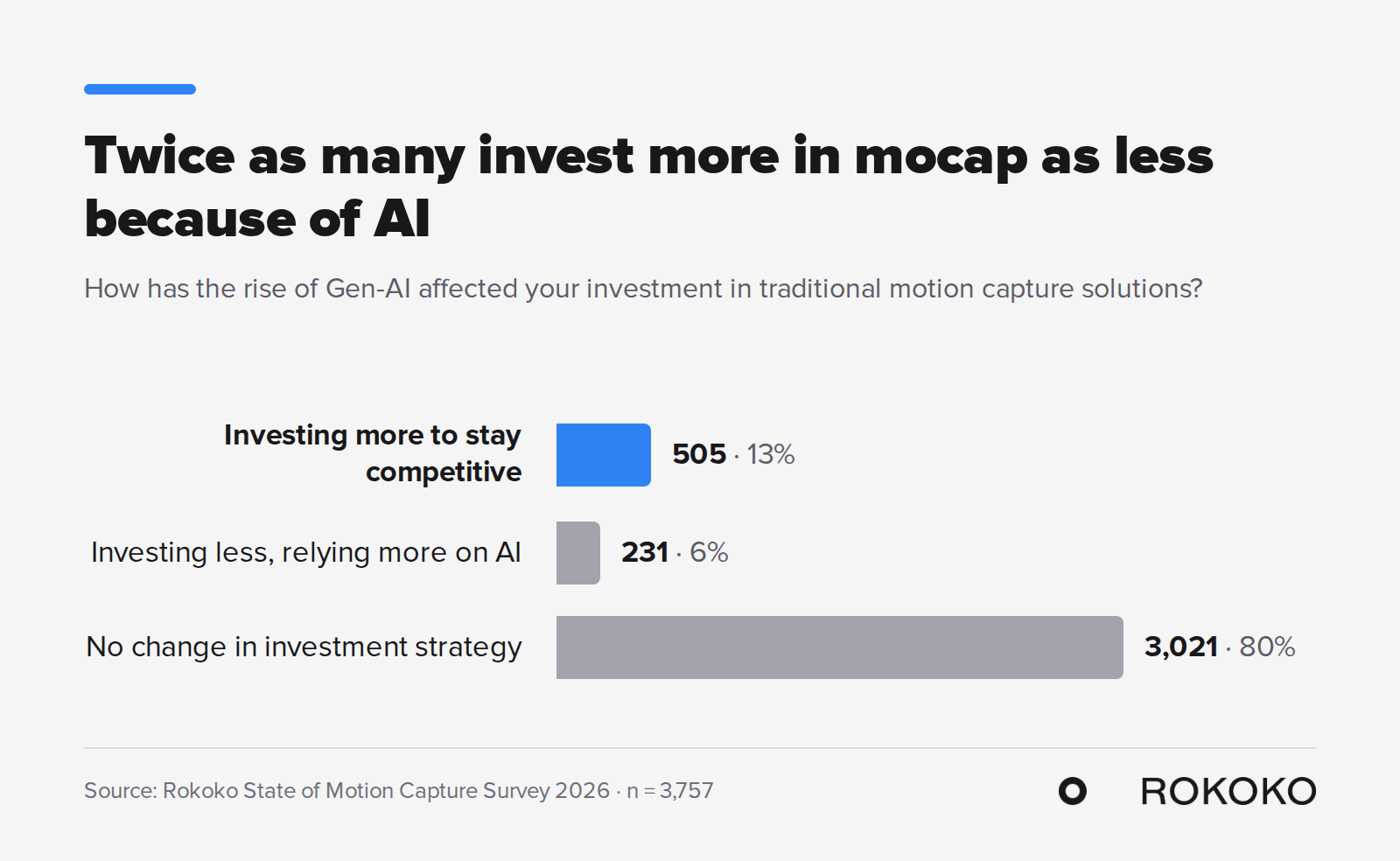
The overwhelming majority - 3,021 respondents, or 80.4% - said it had caused no change to their hardware investment strategy. But among those who had changed their strategy, something unexpected happened.
505 respondents said they were investing more in motion capture to stay competitive. Only 231 said they were investing less and relying more on AI. In other words, respondents were more than twice as likely to say AI had increased their investment in mocap as to say it had reduced it. That’s an interesting counterpoint to the idea that generative AI and motion capture are necessarily competing technologies.
One possible explanation is that AI is increasing the amount of content creators can produce - and therefore increasing their need for reliable ways of creating and controlling high-quality motion. Another is simply that the two technologies solve different problems.
Generative tools are extraordinarily powerful when the goal is to create something quickly from limited input. Motion capture is powerful when the creator needs direct control over a performance, consistency across shots, repeatability and motion that can be edited and integrated into a larger 3D pipeline.
Increasingly, creators may simply use both.
All of this is happening while budgets get tighter
There is an important backdrop to these technology shifts: money.
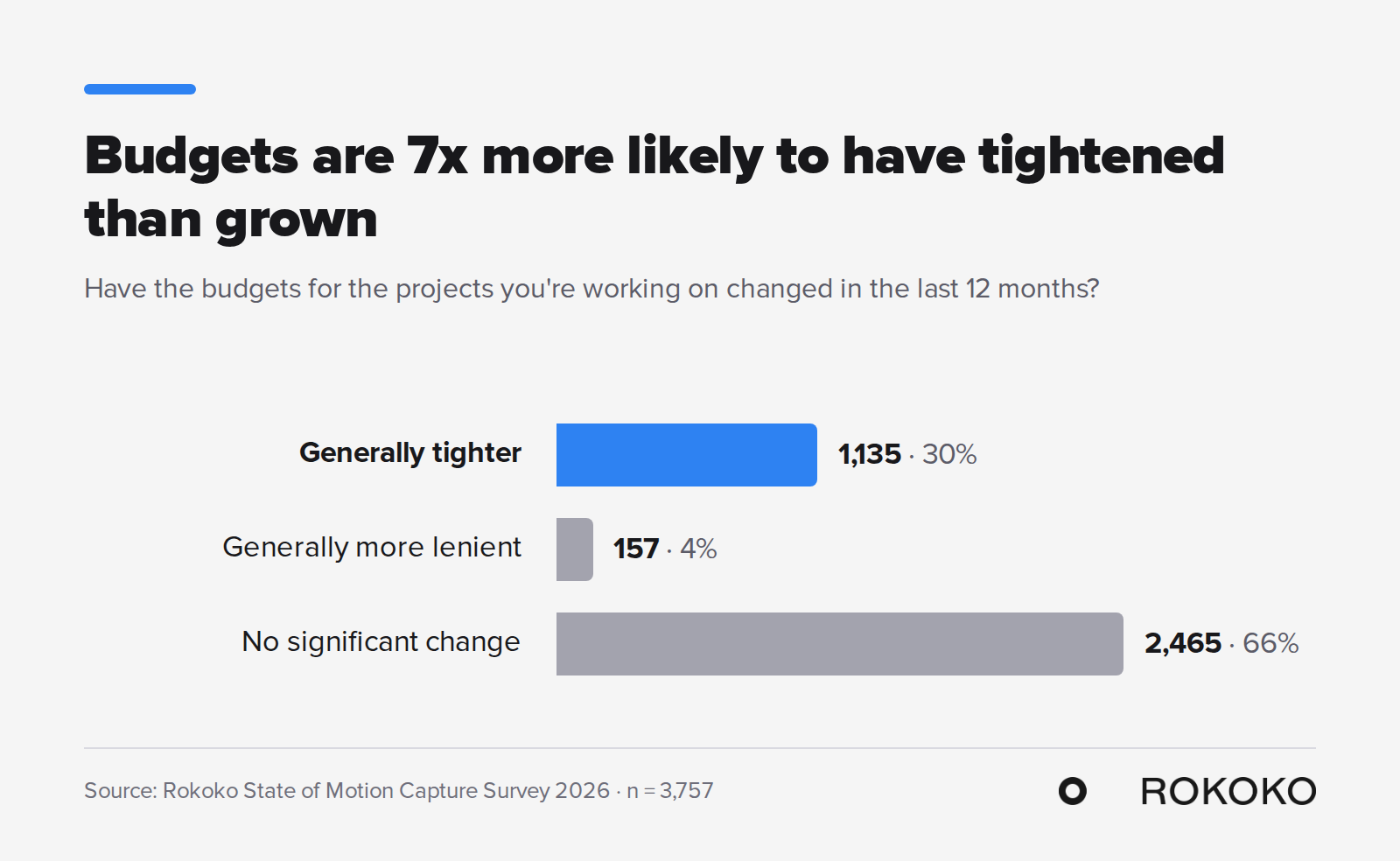
Most respondents - 2,465 - said their project budgets hadn’t changed significantly over the previous 12 months. But among those who had seen a change, the direction was overwhelmingly negative.
1,135 respondents said budgets had become tighter, while only 157 said they had become more lenient. That’s more than seven people reporting tighter budgets for every one reporting expanding budgets. It matches something we’ve heard anecdotally across the industry: creators are being asked to do more with less.
And that context matters when interpreting almost every other result in this survey.
The growth of Unreal Engine, Blender, accessible motion capture and AI tools isn’t happening in an environment of unlimited experimentation budgets. It’s happening while studios and independent creators are under pressure to produce more efficiently.
So, what does the 3D creation landscape look like in 2026?
If there is one conclusion we take from these 3,757 responses, it’s that 3D creation is changing quickly - but not necessarily in the way the headlines suggest.
Generative AI is clearly becoming part of the creator toolkit. People are experimenting with it, paying for it and increasingly incorporating it into production. But it hasn’t replaced the underlying 3D production stack.
Game development and real-time workflows are becoming more dominant. Unreal Engine has established a remarkable lead among this audience. Dedicated motion capture remains widely used. And creators who say AI has changed their mocap investment are actually more likely to be investing more, not less. Perhaps that’s because the future isn’t really AI versus motion capture, or AI versus 3D tools more generally. It’s a larger toolset.
Creators now have more ways than ever to generate ideas, performances, environments, characters and finished content. AI can remove steps that used to take hours or days. Real-time engines can bring entire production pipelines into one environment. And motion capture can give creators direct control over human performance without having to animate every movement by hand.
The interesting question for the next few years won’t be which one of these technologies “wins.” It will be how creators combine them. And if our 2026 survey is any indication, that combination is only just beginning to take shape.
Methodology note: The State of Mocap Q3 2026 survey received 3,757 submissions. The survey was conducted and promoted by Rokoko, meaning respondents are likely to over-index toward people interested in motion capture and toward existing Rokoko users. Results should therefore be interpreted as a snapshot of this audience rather than representative market-share data for the entire 3D content creation industry. Some questions allowed multiple selections or were answered by a subset of respondents.
.jpg)