What Finger Tracking Device Should You Choose in 2026?
Rokoko Smartgloves II vs. Manus (and what actually matters)
If you’re searching for the best finger tracking gloves in 2026, you’ve probably realized something: capturing high-quality hand and finger motion is still one of the hardest problems in motion capture.
Full-body camera systems have improved dramatically. AI-based monocular tracking is impressive. But when it comes to accurate, reliable finger tracking, especially for film, games, XR, and robotics, wearables remain the gold standard.
In this guide, we’ll break down:
- Why camera-based systems struggle with fingers
- Why wearable gloves are still necessary
- A direct comparison between Rokoko Smartgloves II and Manus Gloves
- What to prioritize depending on your use case
Why cameras still struggle with finger tracking
Finger motion is fundamentally different from body motion.
Here’s why:
1. Scale and detail
Hands operate in a very small physical space. The distance between subtle gestures can be millimeters. Capturing that level of detail from cameras positioned meters away is extremely difficult.
2. Occlusion
Fingers constantly block each other. Hands block themselves. Hands block each other. Hands hold props.
Even multi-camera optical systems (e.g. OptiTrack or Qualisys) struggle with consistent finger visibility when actors interact naturally.
3. Interaction with objects
As soon as you introduce tools, weapons, controllers, robotics interfaces, or physical props, occlusion and tracking instability increase dramatically.
Conclusion:
If high-quality finger capture is mission-critical, you need a wearable solution.
Wearable finger tracking: What options exist?
In 2026, the high-end wearable finger tracking space is primarily led by:
- Rokoko Smartgloves II
- Manus (Quantum / Prime series)
- Smaller players such as StretchSense
Among these, Manus is typically positioned as the premium, high-end solution, particularly in optical studio environments and within robotics. Rokoko Smartgloves II are designed to deliver professional-grade performance at a radically more accessible price point, with added portability and ecosystem integration.
Let’s compare.
Rokoko Smartgloves II vs. Manus Gloves
1. Design philosophy
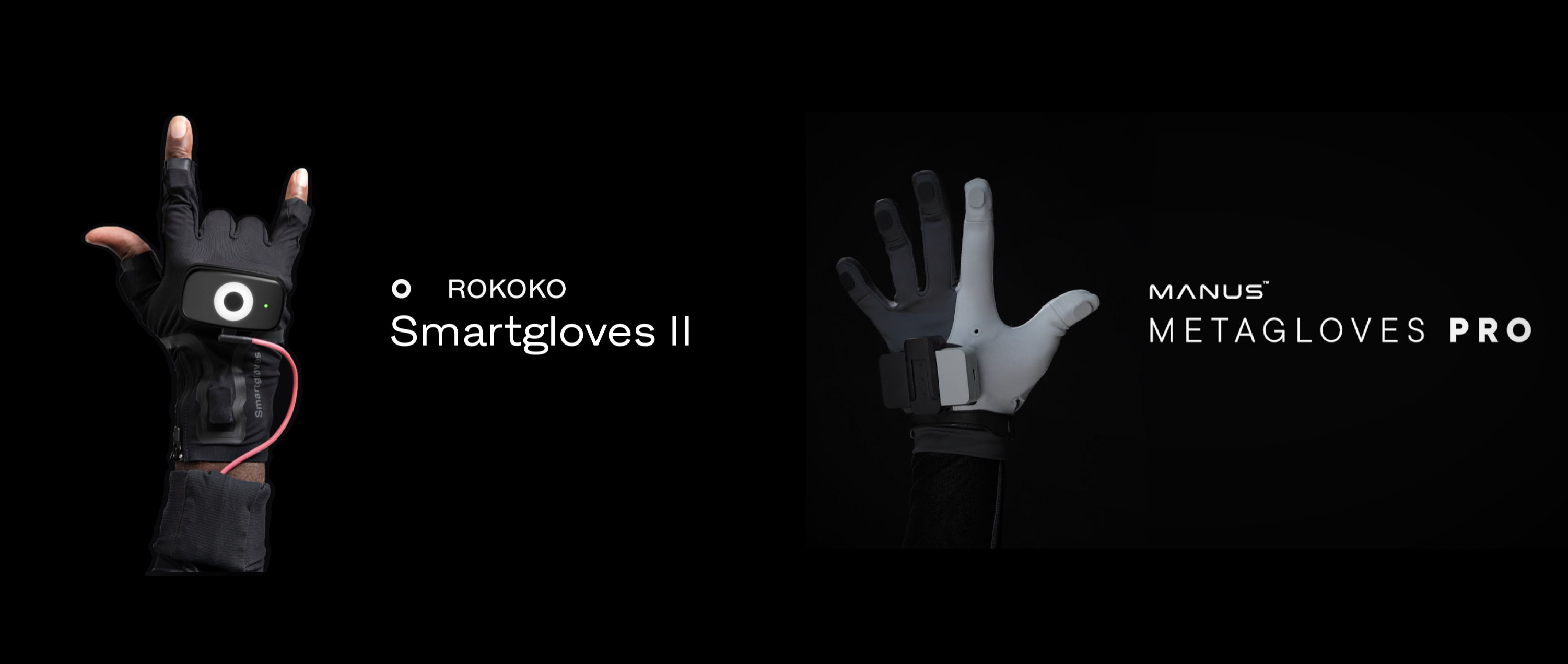
Fingertip sensors vs. Open fingertips
One of the biggest design differences:
Manus gloves
- Include sensors at the very tip of each finger
- Fingertips are covered
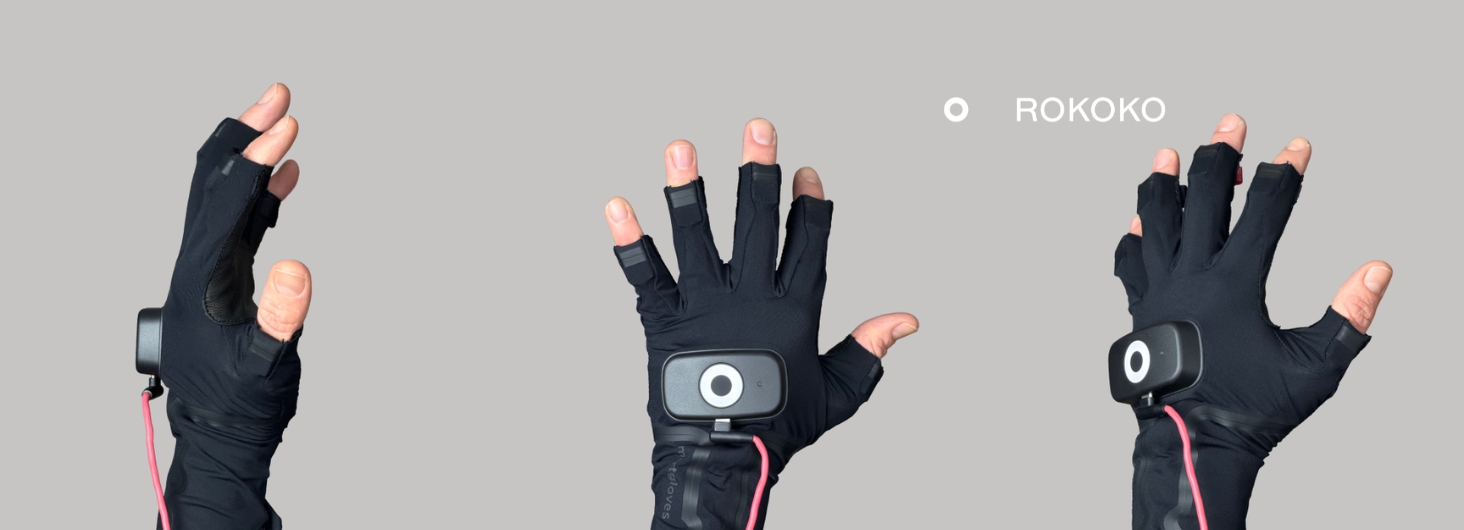
Rokoko Smartgloves II
- Fingertips are open
- No sensor directly on the extreme fingertip
- Includes a wrist/hand tracker
At first glance, fingertip sensors might seem like a clear advantage. More data points = more precision, right?
Not necessarily.
The reality of fingertip tracking
Manus gloves rely on IMUs with magnetometers along with EMF tracking. Fingertips are the part of the hand most likely to:
- Touch metal
- Grip tools
- Rest on surfaces
- Interact with machinery
Magnetometers and magnetic fields are sensitive to electromagnetic interference. Placing sensors on the most interaction-heavy part of the hand increases exposure to drift when touching objects.
For prop-heavy shoots, robotics, or industrial use cases, this matters.
The “Snap” problem
Even with fingertip sensors, no glove can truly measure the exact physical contact point between two fingers.
Why?
- Every hand has different finger lengths.
- Flexibility varies significantly between individuals.
- Thumb articulation differs dramatically person-to-person.
So when fingers get “close enough,” systems must visually snap them together in software.
Example:
If an actor gestures “this small” (a millimeter gap), some systems may visually collapse that space into contact due to snapping thresholds.
This is not a flaw of one brand - it’s an inherent limitation of digital hand models.
Tactile feedback
With covered fingertips, actors lose direct skin contact when touching objects.
Open fingertips:
- Preserve natural tactile feedback
- Improve dexterity
- Feel more natural for long shoots
This was a deliberate design decision with Smartgloves II.
2. Absolute positioning & portability
Absolute positioning and portability is a major differentiator between Manus gloves and Rokoko Smartgloves.
Manus
- The most battle-tested high-end incumbent company in the finger tracking space
- Often paired with studio setups like OptiTrack or Qualisys
- Absolute global positioning depends on external tracking infrastructure
Rokoko Smartgloves II + Coil Pro
With the Coil Pro system:
- You get absolute positioning
- No external optical stage required
- Fully portable
- Set up on location
- Capture hands in global 3D space
This is especially important for:
- Robotics training
- On-location shoots
- Research environments
- Portable production pipelines
Bringing an entire optical system on location is expensive and impractical. A portable inertial + Coil setup dramatically lowers that barrier.
For robotics applications, global spatial accuracy is not optional - it’s fundamental.
3. Ecosystem integration
Manus
- Strong optical integrations
- Premium studio environments
Rokoko
- Full-body + gloves + face capture ecosystem
- Seamless integration inside Rokoko Studio
- Roadmap includes expanded optical integrations
Smartgloves II are part of a broader motion capture stack, not a standalone tool.
4. Pricing
This is where the gap becomes very significant.
Rokoko Smartgloves II
- Pre-order price until 24th of April: $1,795
- Full price: $1,995
Manus
- Hardware pricing is significantly higher
- Often estimated at 3–5x higher hardware cost
- Additional software licenses required
- Optical systems add further cost
For many studios, indie teams, robotics startups, and universities, the price difference alone can define feasibility.
Side-by-Side Comparison
What should you choose in 2026?
It depends on your environment.
Choose Manus if:
- Budget is less of a constraint
- You want to get the most high-end solution that’s been on the market for longest
- Having sensors on the last joint of the fingers is important for your use-case (see above for pros/cons)
Choose Rokoko Smartgloves II if:
- You need portability
- You work on location
- You’re in robotics or AI research
- You want high-quality capture without a six-figure stage
- You value tactile realism
- You want a full capture ecosystem
Final thoughts
Finger tracking is not solved by cameras alone. Not in 2026.
If your project depends on believable hands - and increasingly, AI models, digital humans, and robotics do - then the question isn’t whether you need a wearable.
It’s which wearable fits your workflow.
The key decision points are:
- Portability vs. studio infrastructure
- Tactile realism vs. fully enclosed fingertip sensors
- Absolute positioning requirements
- Budget
The good news?
You no longer need to choose between quality and accessibility.

-min.jpg)


