
From X-men to Love, Death + Robots: The Journey of Animator Thomas Price
Thomas Price speaks to Rokoko about career highlights, the future of the industry, and how Rokoko fits into the workflow of a creator who’s constantly pushing the limits of what’s possible. From humble beginnings experimenting with early 3D tools, to helping bring to life standout cinematic moments in X-Men: Days of Future Past, Love, Death & Robots, and beyond. Thomas approaches animation with equal parts artistry, curiosity, and joyful experimentation.
How did you get your start in the industry?
It was the mid 1990's, the early Pixar short films were out, which blew my mind at the time. I fell in love with the idea that something could be created from seemingly nothing, and you could fall in love with stories and characters that were only limited by time and imagination. That thinking rocketed off into the next level with the release of Toy Story in 1995, and I caught the bug. The early 2000's brought with it more films like Shrek, and Final Fantasy: Spirits within. As this point, I knew it was what I wanted to do, and spent every waking moment practising and trying to find tutorials to learn the early 3D programs at the time (pre-YouTube!). With my parents blessing, I left my remote country home at the bright old age of 15 and lived with an old diving buddy of my Dad's in the city, to study an early Animation course at community college. Fast forward a few years and I got my first job in the industry, working at Photon VFX on the Gold Coast in Queensland, on a children’s animated series called Animalia. I started as a junior modeller, modelling props and the like.
Around that time Disney Toon in Sydney (Disney's Sydney studio) shut down, and Photon had the brilliant move of hiring experienced 2D animators, that didn't have any 3D animation experience. They paired us junior modellers/riggers up with an experienced animator as a mentor, and the next couple of years was basically being shown the ropes by a guy with 20+ years traditional Disney experience, it was an experience you couldn't pay for and I was extremely grateful for it. Having both Modelling and Animation experience after a couple of years on that show, I eventually made my way down to Animal Logic in Sydney, and worked in both departments there for a few years, that got me my break from TV into Film, then it was on to the studios in London, New Zealand, China, and all around Australia.
Where does Rokoko fit into your workflow/production pipeline?
I'm a bit of a risk taker by nature, and I like to think outside of the box. A few years ago, I took a punt on a Rokoko suit/gloves with the intention of allowing it to help me create more personal work. Partnered along with the two decades long experience in Character Animation, I found it worked so successfully, I couldn't stop. I've worked out a workflow that really works for me, and I find even if it's just to use a captured skeleton in my scene as a kind of "3D reference footage", it's elevated my work and allows me time to experiment in new ways. I've found I can use it on all kinds of projects from toony through to hyper realistic, depending on the editing I do to it afterwards.
I find there's sometimes a stigma from more cartoony animators towards motion capture, and while I see where that might come from, I see motion capture as just another tool to help get to the end result in a faster, more physically accurate way, it's amazing when I think about how many different styles I've used it on, and because it wasn't relevant, many of those clients had no idea I was using motion capture ( sometimes heavily edited) at the time.
What has been the standout/most rewarding moment of your career?
When I was working at Rising Sun Pictures in Adelaide, myself and a handful of artists were working on the "Pentagon Kitchen Scene" for X-Men: Days Of Future Past. We all knew it was pretty special for the 7 months or so we were working on that scene, but I'm not sure anyone but Bryan Singer knew how iconic it was going to be. I remember after it got the Oscar nomination and our VFX Supervisor got sent over to the Oscars to represent us, we were all watching the Oscars together in the studio theatre. I remember just being so proud to be a part of that.
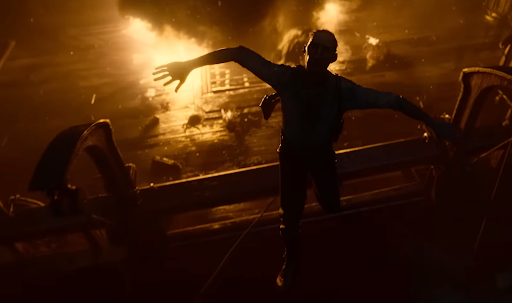
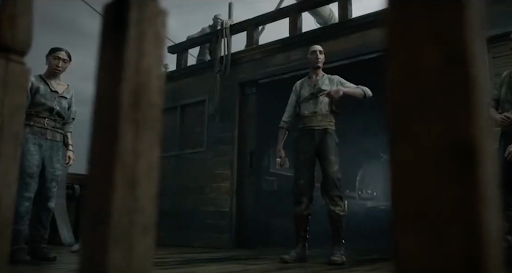
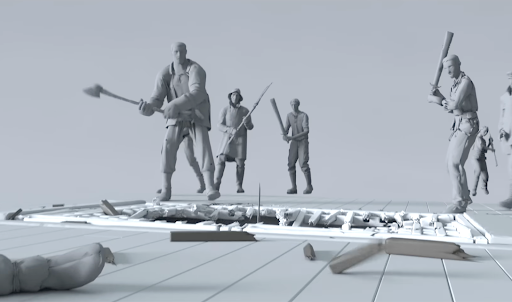
Another memorable moment more recently, was spending 6 glorious months working on David Fincher's first animated piece, "Bad Travelling" for Love, Death and Robots on Netflix, with Little Zoo and Blur Studios. It was kind of a surreal experience, having David Fincher give notes on my work, getting a glimpse of how his brain works in reviews, and just being a part of that unbridled storytelling. Love, Death and Robots is something I'm really proud to have worked on a few times, if you haven't seen it yet, check it out! (A bit more on that project here).
With the rise of AI and machine learning, how do you see these technologies integrating into 3D animation? Are you excited or concerned about these advancements?
Ultimately I'm an optimist by nature. It's here, and it's a genie that's not going back in a bottle, so I'm constantly looking for ways to embrace it. I already use AI to help me write useful Python scripts for Maya tools to help with animation, albeit it can take upwards of 120 iterations before I get something useful out of it, but I can see how this will only get smarter and more helpful as time goes on and these technologies advance.
What ethical considerations do you think animators should keep in mind when creating characters and worlds, especially in terms of representation and impact?
I think really, part of the beauty of animation is that it can be so unbridled and free. Like most artists, I'm a big fan of sharing your thoughts, ideas and dreams with the world, only limited by your imagination. In terms of impact and representation, I'd give the advice that was given to me "Just do what you want to do". Good work will find its audience, great messages will hit their mark. What we do is all about story, and if the story sucks, it doesn't really matter what you're saying.
What’s the strangest or most unusual piece of feedback you’ve received, and how did it influence your work?
Possibly when working on a show where there was a character who was part zombie with intestines hanging out, and I was getting these notes on how the intestines should dangle. We sometimes get so immersed in our work it isn't until afterwards that you realise how funny and strange a thing that is to be working on. On a lighter note, back before I could animate, I didn't know I couldn't animate. One of those older experienced Disney mentors walked past my desk, as I was (very badly) animating a boy on the back of a horse. He tried to give me some constructive feedback, and being fresh and inexperienced, I didn't take it very well. My point is this, learning to take feedback, was one of the hardest but most important things I ever did in terms of being an animator. If I could pass that on to fresh animators starting out today, as hard as it is to have someone tear apart the work you've tried so hard to make, if they know what they are doing, try to listen to them, you just might learn something.
If you could collaborate with any historical figure (from any field) on a 3D animation project, who would it be and why?
Oh gosh, what a question. I think a collab with Nikola Tesla and David Bowie would get pretty wild! (I love that Bowie played Tesla in "The Prestige"). We'd make something "electric" together, pun definitely intended.
Looking into your crystal ball, what are the immediate challenges facing the industry? And what’s exciting you about the future of the industry?
I see a lot of fear around AI, but overall for me, I'm kind of excited by it, with a hint of perplexity thrown in there for good measure ha... I think it'll be a delicate balance working out where its uses and place is, but I think ultimately we're artists, and will figure out cool new ways of using cool new tools. I'm excited to see where both hardware and software continue to go in the next 10 years. I have a feeling we'll see some pretty amazing stuff, and I hope ultimately more tools will continue to help remove the technological barriers of creating great digital art. Anything that makes that easier is a win in my books haha.
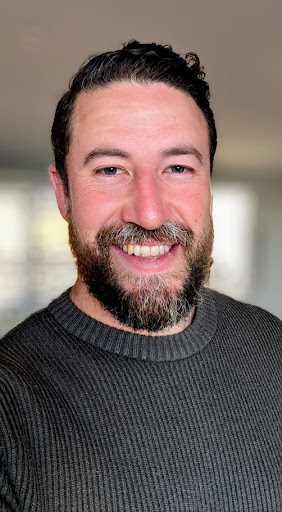
Hearing Thomas speak about his craft, it’s clear that the future of animation belongs to creators willing to experiment, iterate, and embrace emerging technologies with optimism. We’re grateful to have him in the Rokoko community and can’t wait to see what worlds he builds next!


